Electric Charges and Fields Class 12 Notes – Formulas, Derivations & Numericals | EyLinx
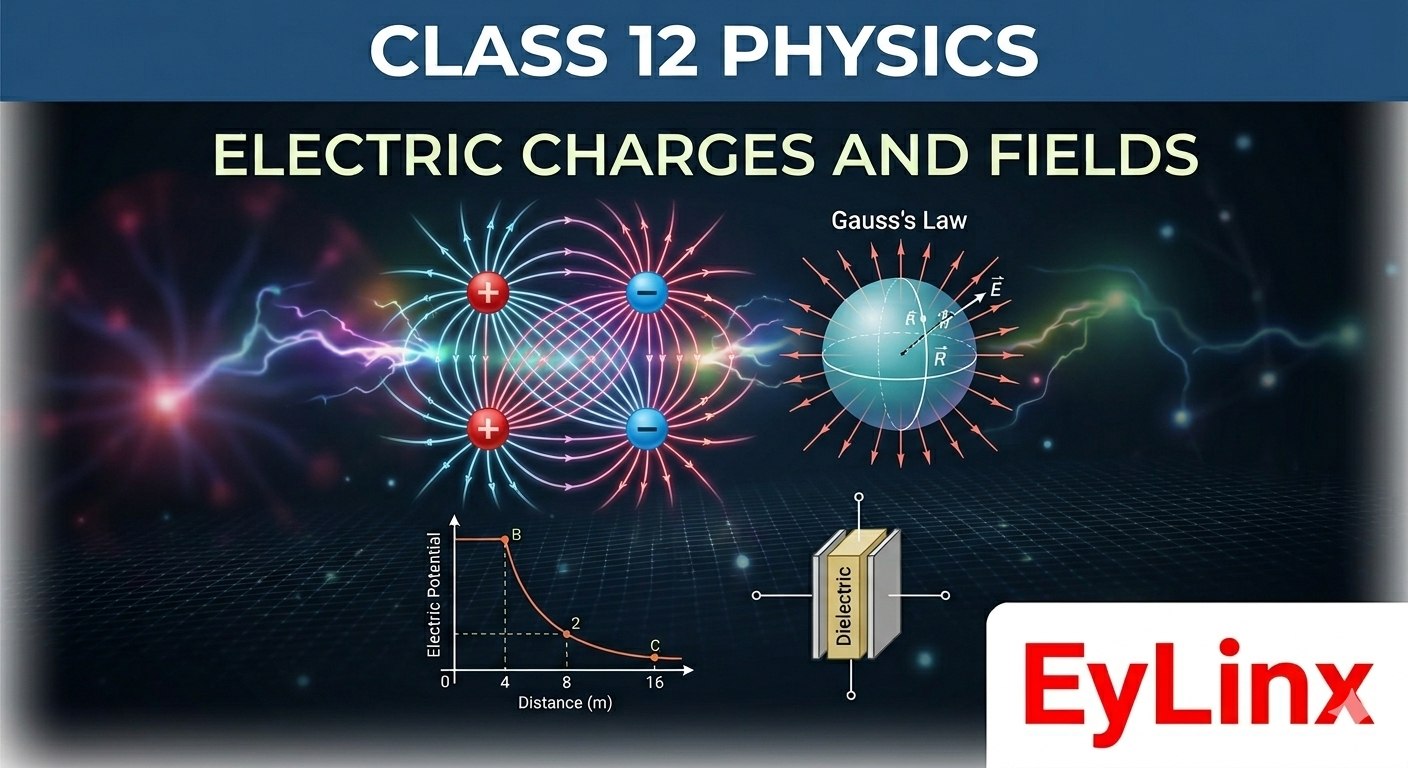
Electric Charges and Fields Class 12 Notes – Complete Chapter with Formulas, Derivations & Numericals
Are you looking for the best Electric Charges and Fields Class 12 notes? You are at the right place!
Welcome to EyLinx — Empowering Youth Linked with eXcellence.
"Hum Excellence Ka Peecha Karte Hain, Taki Kaamyaabi Khud Chalkar Aaye."
In this Anil Sir — with 15 years of Physics teaching experience — has covered the complete Chapter 1 of Class 12 Physics, including all important concepts, formulas, derivations, solved numericals, MCQs, and previous year questions for CBSE Board, NEET, and JEE Mains.
Whether you are a Class 12 CBSE student, a NEET aspirant, a JEE Mains candidate, or a student of any of the 28 state boards of India — this article will help you master Electric Charges and Fields completely.
? Want to learn Physics with complete video lectures by Anil Sir?
Download the EyLinx App now from Google Play Store:
? Download EyLinx App
✅ Demo classes available on the app — Try before you buy!
✅ Most affordable Physics courses in India
✅ For Class 10, 11, 12 | NEET | JEE | CBSE + All 28 State Boards
? Visit: www.eylinx.com
? WhatsApp: 8595657896
? Email: eylinx.contact@gmail.com
What is Electric Charge?
Electric charge is a fundamental physical property of matter that causes it to experience a force when placed in an electromagnetic field.
There are two types of electric charges:
Positive Charge (+) — carried by protons
Negative Charge (–) — carried by electrons
Key Properties of Electric Charge:
1. Additivity of Charge:
Electric charges add up like real numbers (scalars).
Total charge = q1 + q2 + q3 + ...
2. Conservation of Charge:
Electric charge can neither be created nor destroyed. The total charge of an isolated system always remains constant.
3. Quantisation of Charge:
Electric charge always exists in integral multiples of the basic unit of charge (e).
q = ne
Where n = 0, ±1, ±2, ±3... and e = 1.6 × 10⁻¹⁹ C
Coulomb's Law — Most Important Formula
Coulomb's Law states that the electrostatic force between two point charges is:
Directly proportional to the product of the two charges
Inversely proportional to the square of the distance between them
Formula:
F = k × (q1 × q2) / r²
Where:
F = Electrostatic force (in Newtons)
q1 and q2 = Two point charges (in Coulombs)
r = Distance between the charges (in metres)
k = Coulomb's constant = 9 × 10⁹ N m² C⁻²
Also written as:
k = 1 / (4πε₀)
Where ε₀ = 8.85 × 10⁻¹² C² N⁻¹ m⁻² (permittivity of free space)
Important Points About Coulomb's Law:
It applies to point charges only
The force is attractive between unlike charges and repulsive between like charges
It follows the inverse square law (similar to Newton's law of gravitation)
It is a central force — acts along the line joining the two charges
In a medium with dielectric constant K: F = kq1q2 / (r²)
Superposition Principle
When multiple charges are present, the total force on any one charge is the vector sum of forces due to all other individual charges.
F_total = F₁₂ + F₁₃ + F₁₄ + ...
This is called the Superposition Principle and it is one of the most important concepts for JEE problems.
Electric Field
The electric field at a point is defined as the force experienced by a unit positive test charge placed at that point, without disturbing the original charge distribution.
Formula:
E = F / q₀
Where:
E = Electric field intensity (N/C or V/m)
F = Force on the test charge
q₀ = Small positive test charge
Electric Field Due to a Point Charge:
E = kq / r²
Or:
E = q / (4πε₀r²)
Direction: Away from positive charge, towards negative charge.
Electric Field Lines — Key Properties
Electric field lines are imaginary lines drawn to represent the electric field visually. Their important properties are:
Field lines start from positive charges and end on negative charges
They never intersect each other
The tangent at any point gives the direction of electric field at that point
They are closer where the field is stronger
They are always perpendicular to the surface of a conductor
Electric field lines do not form closed loops
Electric Dipole
An electric dipole consists of two equal and opposite charges +q and –q separated by a small distance 2a.
Electric Dipole Moment:
p = q × 2a
Direction: From –q to +q
Unit: C·m (Coulomb-metre)
Electric Field on Axial Line (End-On Position):
E_axial = (1/4πε₀) × 2p / r³
Direction: Along dipole moment (from –q to +q)
Electric Field on Equatorial Line (Broadside-On Position):
E_equatorial = (1/4πε₀) × p / r³
Direction: Opposite to dipole moment
Very Important Relation:
E_axial = 2 × E_equatorial (at the same distance r)
Torque on a Dipole in Uniform Electric Field:
τ = pE sinθ
Vector form: τ = p × E
When θ = 0° → τ = 0 (stable equilibrium)
When θ = 90° → τ = pE (maximum torque)
When θ = 180° → τ = 0 (unstable equilibrium)
Gauss's Law — Critical for NEET & JEE
Gauss's Law states that the total electric flux through any closed surface is equal to 1/ε₀ times the net charge enclosed within that surface.
Formula:
Φ = q_enclosed / ε₀
Where:
Φ = Total electric flux (N m² C⁻¹)
q_enclosed = Net charge inside the Gaussian surface
ε₀ = 8.85 × 10⁻¹² C² N⁻¹ m⁻²
Electric Flux:
Φ = E × A × cosθ
Where θ = angle between electric field E and area vector A.
Applications of Gauss's Law
1. Electric Field Due to Infinite Line Charge:
E = λ / (2πε₀r)
Where λ = linear charge density (C/m), r = perpendicular distance
2. Electric Field Due to Infinite Plane Sheet:
E = σ / (2ε₀)
Where σ = surface charge density (C/m²)
This field is uniform and independent of distance — very important for NEET!
3. Electric Field Due to Uniformly Charged Spherical Shell:
Position
Electric Field
Outside shell (r > R)
E = q / (4πε₀r²)
On the surface (r = R)
E = q / (4πε₀R²)
Inside the shell (r < R)
E = 0
Electric field inside a hollow charged shell is always ZERO — this is one of the most repeated NEET questions!
Complete Formula Summary Table
Formula
Meaning
q = ne
Quantisation of charge
F = kq1q2/r²
Coulomb's Law
k = 9 × 10⁹ N m² C⁻²
Coulomb's constant
E = F/q₀
Electric field definition
E = kq/r²
Field due to point charge
p = q × 2a
Electric dipole moment
E_axial = 2p/4πε₀r³
Field on axial line
E_equatorial = p/4πε₀r³
Field on equatorial line
τ = pE sinθ
Torque on dipole
Φ = q/ε₀
Gauss's Law
E = λ/2πε₀r
Field due to line charge
E = σ/2ε₀
Field due to plane sheet
Solved Numericals
Numerical 1 — CBSE Board Level:
Two charges +6μC and –6μC are placed 12 cm apart. Find the force between them.
Solution:
q1 = +6 × 10⁻⁶ C, q2 = –6 × 10⁻⁶ C
r = 12 cm = 0.12 m
k = 9 × 10⁹ N m² C⁻²
F = k × |q1 × q2| / r²
F = (9 × 10⁹) × (6 × 10⁻⁶) × (6 × 10⁻⁶) / (0.12)²
F = (9 × 10⁹) × (36 × 10⁻¹²) / (0.0144)
F = 22.5 N (Attractive force)
Numerical 2 — NEET Level:
An electric dipole has charges ±4μC separated by 2mm. Find the dipole moment.
Solution:
q = 4 × 10⁻⁶ C
2a = 2 × 10⁻³ m
p = q × 2a
p = 4 × 10⁻⁶ × 2 × 10⁻³
p = 8 × 10⁻⁹ C·m
Numerical 3 — JEE Level:
A charge of 5μC is placed at the centre of a cube of side 10cm. Find the electric flux through one face of the cube.
Solution:
Total flux = q / ε₀
Φ_total = (5 × 10⁻⁶) / (8.85 × 10⁻¹²)
Φ_total = 5.65 × 10⁵ N m² C⁻¹
Flux through one face = Φ_total / 6
= 9.41 × 10⁴ N m² C⁻¹
NEET Previous Year Questions
Q1. (NEET 2022): If the radius of a Gaussian surface enclosing charge Q is doubled, the electric flux will:
(a) Increase 4 times (b) Decrease 4 times (c) Remain the same ✅ (d) Double
Explanation: Φ = q/ε₀ — flux depends only on enclosed charge, not on surface size.
Q2. (NEET 2020): Electric field inside a spherical shell of uniform surface charge is:
(a) Zero ✅ (b) Constant non-zero (c) Proportional to r (d) Inversely proportional to r²
Q3. (NEET 2019): At the midpoint between +q and –q charges, electric field is:
(a) Zero (b) Towards +q (c) Towards –q ✅ (d) Perpendicular to line
Practice MCQs — Test Yourself
Q1. SI unit of electric field intensity is:
(a) N/C² (b) C/N (c) N/C ✅ (d) C²/N
Q2. Coulomb's Law is valid for:
(a) Moving charges (b) Point charges ✅ (c) Large conductors (d) Magnetic dipoles
Q3. Electric field inside a conductor in electrostatic equilibrium is:
(a) Maximum (b) Infinite (c) Zero ✅ (d) Equal to surface field
Q4. Quantisation of charge means:
(a) q = ne ✅ (b) Charge can have any value (c) Charge is always positive (d) Charge cannot be transferred
Q5. Torque on dipole placed parallel to electric field is:
(a) Maximum (b) pE (c) Zero ✅ (d) pE/2
Frequently Asked Questions (FAQs)
Q1. What is Coulomb's constant k?
k = 9 × 10⁹ N m² C⁻² = 1/(4πε₀)
Q2. What is SI unit of electric charge?
Coulomb (C).
Q3. Can electric field lines cross each other?
No. Electric field has only one direction at any point, so field lines can never cross.
Q4. What is electric field inside a hollow charged conductor?
Always zero — direct result of Gauss's Law. Very frequently asked in NEET.
Q5. What is the difference between axial and equatorial field of a dipole?
E_axial = 2 × E_equatorial at the same distance r.
Q6. Is Coulomb's Law valid in a medium?
Yes. In a medium with dielectric constant K: F = kq1q2 / (Kr²)
Q7. What is the value of charge on an electron?
e = –1.6 × 10⁻¹⁹ C
Key Points to Remember
✅ Electric field inside a conductor = Zero
✅ Electric field lines never intersect
✅ Gauss's Law flux = q/ε₀ (independent of surface size)
✅ E_axial = 2 × E_equatorial for electric dipole
✅ Force in medium = F_vacuum / K
✅ Total charge of isolated system is conserved
✅ k = 9 × 10⁹ N m² C⁻²
✅ Charge on electron = –1.6 × 10⁻¹⁹ C
✅ Charge on proton = +1.6 × 10⁻¹⁹ C
✅ Electric field inside spherical shell = Zero
Study Physics with Anil Sir — Only on EyLinx
If these notes helped you, imagine what complete video lectures by Anil Sir can do for your preparation!
Anil Sir brings 15 years of Physics teaching experience directly to your phone through the EyLinx platform — at the most affordable price in India.
Why Choose EyLinx?
✅ Complete Class 10 Physics lectures
✅ Complete Class 11 Physics lectures
✅ Complete Class 12 Physics lectures
✅ NEET Physics full course
✅ JEE Physics full course
✅ Available for CBSE + all 28 State Boards of India
✅ Demo classes available — experience the teaching before enrolling
✅ Most affordable Physics platform in India
✅ Study anytime, anywhere on your Android phone
"EyLinx — Empowering Youth Linked with eXcellence"
"Hum Excellence Ka Peecha Karte Hain, Taki Kaamyaabi Khud Chalkar Aaye."
? Download EyLinx App Now:
? Click Here to Download EyLinx App from Google Play Store
For pricing and discounts on all courses — download the EyLinx App from Play Store.
? Visit Our Website:
www.eylinx.com
? WhatsApp Us:
8595657896
? Email Us:
eylinx.contact@gmail.com
Electric Charges and Fields Class 12, Class 12 Physics Chapter 1 Notes, Coulomb's Law, Gauss's Law, Electric Dipole, NEET Physics Notes 2025, JEE Physics Notes, CBSE Class 12 Physics, EyLinx, Anil Sir Physics, Affordable Physics Coaching India